
Spark plugs are one of the most overlooked components in your engine, yet they play a critical role every time you turn the key. These small but essential parts are responsible for igniting the air-fuel mixture inside each cylinder, and when they start to wear out, the effects can ripple across your engine's performance, fuel economy and emissions.
At Stedmans Garage, we have been keeping Worthing's cars running smoothly since 1923. Spark plug replacement is one of the most common jobs we carry out, and in this guide we will walk you through everything you need to know - from how spark plugs work to the warning signs that yours need replacing.
What Do Spark Plugs Actually Do?
A spark plug sits at the top of each engine cylinder and delivers a precisely timed electrical spark to ignite the compressed air-fuel mixture. This controlled explosion is what drives the piston down and ultimately powers your wheels.
Each spark plug fires thousands of times per minute when your engine is running. Over time, the electrode at the tip wears down, the gap widens, and the spark becomes weaker. When that happens, combustion becomes less efficient and your engine has to work harder to deliver the same performance.
Modern engines typically use one spark plug per cylinder, so a four-cylinder engine will have four plugs, a six-cylinder will have six, and so on. Some high-performance and diesel-adjacent petrol engines use twin-spark setups with two plugs per cylinder.
How Often Should Spark Plugs Be Replaced?
Replacement intervals vary depending on the type of spark plug fitted and the manufacturer's recommendations:
- Copper/nickel plugs - typically every 20,000 to 30,000 miles
- Platinum plugs - typically every 40,000 to 60,000 miles
- Iridium plugs - typically every 60,000 to 100,000 miles
Most modern vehicles come with iridium or platinum plugs as standard, which means many drivers can go several years between changes. However, this also means spark plugs are easy to forget about entirely.
Your vehicle's service schedule will specify when spark plugs should be inspected and replaced. A full or major service at Stedmans includes checking the condition of your spark plugs as part of the ignition system inspection.
7 Warning Signs Your Spark Plugs Need Replacing
Worn spark plugs rarely fail without warning. Here are the most common symptoms to watch for:
1. Engine Misfires
A misfire occurs when the air-fuel mixture in a cylinder fails to ignite properly or at the right time. You may feel a judder, stumble or momentary loss of power while driving. Worn spark plugs are one of the most common causes of engine misfires, and misfire-related fault codes like P0300 (random/multiple cylinder misfire) frequently point back to plug condition. If you drive a Ford with an EcoBoost engine, misfires can trigger specific diagnostic fault codes that our technicians can read and diagnose.
2. Rough Idling
If your engine feels uneven or shaky when stationary, worn spark plugs could be the cause. An inconsistent spark leads to uneven combustion across the cylinders, which is most noticeable at idle when the engine is under minimal load.
3. Difficulty Starting
Spark plugs that are heavily worn or fouled can struggle to produce a strong enough spark to ignite the fuel on cold starts. If your car is taking longer to turn over than usual, the plugs are worth investigating alongside the battery and starter motor.
4. Poor Fuel Economy
When spark plugs are not firing efficiently, combustion is incomplete. Your engine compensates by using more fuel to maintain the same power output, which shows up at the pump. If your fuel economy has dropped noticeably without a change in driving habits, worn plugs are a common culprit.
5. Lack of Acceleration
Hesitation or sluggishness when you press the accelerator can indicate that one or more cylinders are not firing properly. This is particularly noticeable on vehicles with smaller turbocharged engines where each cylinder's contribution matters more. We see this regularly on VAG group cars - the same ignition system issues that cause coil pack failures on the SEAT Ibiza 1.2 TSI often start with degraded spark plugs.
6. Engine Warning Light
A persistent engine management light can be triggered by misfire codes stored in the ECU. A diagnostic check will reveal the specific fault codes, and in many cases worn spark plugs are the root cause - particularly codes in the P0300-P0312 range which relate to cylinder misfires.
7. Failed Emissions or MOT
Worn spark plugs cause incomplete combustion, which increases harmful exhaust emissions. This can lead to a failed MOT emissions test or trigger emissions-related fault codes. If you are concerned about emissions performance, our guide to emissions fault diagnosis explains how we investigate and resolve these issues.
What Happens During a Spark Plug Replacement?
Replacing spark plugs is a relatively straightforward job for an experienced technician, but it does require care and the right tools. Here is what the process looks like at Stedmans:
- Access the plugs - Depending on the engine layout, this may involve removing engine covers, intake manifolds or coil packs. On some engines (particularly V6 and flat-four configurations) access can be tight.
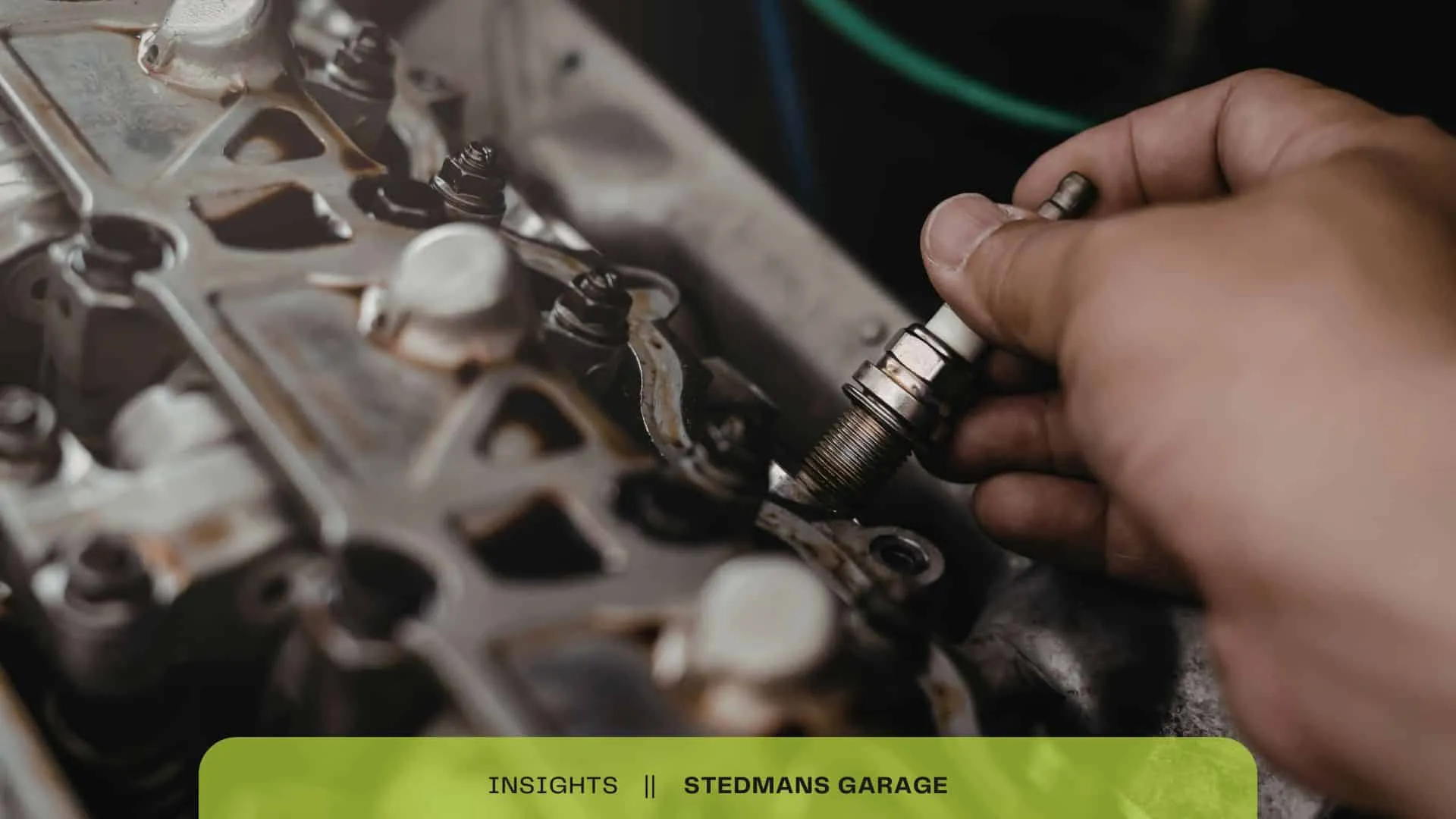
- Remove and inspect - Each plug is removed using a specialist spark plug socket. We inspect the old plugs for wear patterns, fouling, oil contamination or damage, which can tell us a lot about the overall health of the engine.
- Gap check - New plugs are checked to ensure the electrode gap matches the manufacturer's specification. An incorrect gap will affect spark quality and engine performance.
- Torque to specification - Spark plugs must be tightened to a precise torque value. Over-tightening can damage the cylinder head threads, while under-tightening can cause the plug to work loose or fail to seal properly.
- Test and clear codes - After fitting, the engine is started and run to verify smooth operation. Any stored fault codes related to misfires are cleared and the system is monitored to confirm the issue is resolved.
If the ignition coil packs are showing signs of wear at the same time (which is common, as coils and plugs work as a pair), we will recommend replacing those too. On many Audi models, ignition coil failure is a known issue, and replacing plugs and coils together is the most cost-effective approach.
How Much Does Spark Plug Replacement Cost?
The cost of spark plug replacement depends on a few factors:
- Number of cylinders - more cylinders means more plugs
- Plug type - iridium and platinum plugs cost more than copper
- Accessibility - some engine layouts require more labour time to access the plugs
- Additional work - if coil packs or other ignition components need replacing at the same time
As a general guide for most four-cylinder cars, you can expect to pay between £80 and £200 for a full set of quality spark plugs fitted and tested. Six-cylinder and performance engines will typically be higher.
At Stedmans, we always quote before we work. If we discover additional issues during the inspection, we will explain what we have found and give you an honest recommendation before proceeding.
Can You Drive with Worn Spark Plugs?
Technically, yes - but it is not advisable. Driving with worn spark plugs puts additional strain on other engine components, particularly the ignition coils and catalytic converter. A misfiring cylinder sends unburnt fuel into the exhaust system, which can overheat and damage the catalytic converter - a far more expensive repair.
The longer you leave worn plugs, the more likely you are to see secondary problems develop. What starts as a simple plug change can escalate into a more involved engine repair if left unaddressed.
Spark Plugs and Your Service Schedule
Spark plug replacement is typically included as part of a major or manufacturer's service, rather than an interim service. If you are unsure which level of service your car is due, our team can check your vehicle's service history and advise on what is needed.
We recommend not waiting for symptoms to appear. Replacing spark plugs at the manufacturer's recommended intervals is one of the simplest and most cost-effective ways to keep your engine running efficiently, protect your catalytic converter, and maintain clean emissions for your MOT.
Book Your Spark Plug Replacement in Worthing
If you are experiencing any of the symptoms above, or your car is due for a service that includes spark plug replacement, we are here to help.
At Stedmans Garage, we use quality OE-specification spark plugs and have the specialist diagnostic equipment to ensure the job is done properly. Whether you drive a VW, Audi, SEAT, Skoda, Ford, BMW, Jaguar, Land Rover or any other make, we have the expertise and tooling to get it right.
Book online or call us on 01903 691666 to arrange your appointment.
Related reading: Audi A3 maintenance tips