
P1337 VAG Fault Code: Camshaft Position Sensor (G40) Short to Ground
If your VW, Audi, SEAT or Skoda is throwing a P1337 fault code, it’s a specific electrical fault on the camshaft position sensor circuit – not a generic misfire, and not an ignition coil problem. P1337 on the VAG platform is defined as “Camshaft Position Sensor (G40), Bank 1: Short to Ground”. In plain English, the cam sensor’s signal wire (or the sensor’s internal element) has shorted to earth, giving the ECU a permanent 0V reading instead of the expected pulsing signal.
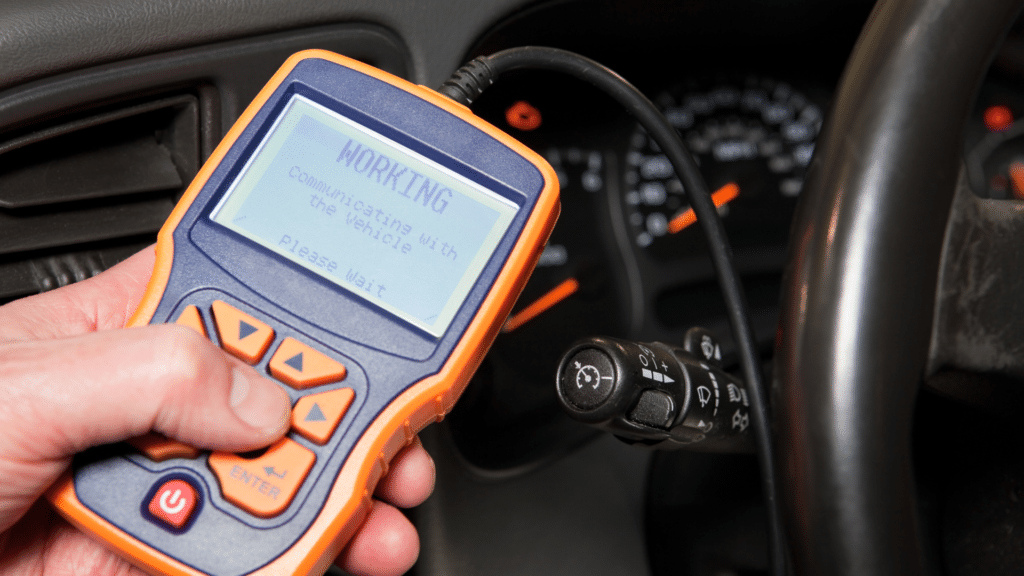
This guide explains what P1337 actually means on a VAG vehicle, the symptoms drivers notice, the realistic causes, and how a workshop diagnoses and repairs it. If you’d prefer a professional VAG-level diagnostic check at our Worthing workshop, we use VAG-specific scan software and oscilloscope test gear so the cam sensor circuit can be properly isolated.
What P1337 actually means on a VAG vehicle
P1337 is a VAG manufacturer-specific Diagnostic Trouble Code (its VAG-internal number is 17745). The “P1” prefix tells you it’s manufacturer-defined rather than a generic SAE J2012 code. On Volkswagen, Audi, SEAT and Skoda vehicles, P1337 is defined as “Camshaft Position Sensor (G40), Bank 1: Short to Ground”.
The camshaft position sensor (component code G40 in VAG terminology) is a Hall-effect sensor mounted at the front of the engine. It detects the rotation of a reluctor wheel on the camshaft and sends a pulsing signal to the engine control unit. The ECU uses that signal alongside the crankshaft position sensor (G28) to know exactly where each piston is in its stroke, which determines ignition and injection timing.
P1337 is logged when the ECU sees the cam sensor signal stuck at or near 0 volts for too long. The sensor’s expected output is a square-wave pulse train; a permanent low reading either means the sensor itself has internally failed in a short-to-earth condition, the signal wire has chafed through and is touching the chassis or another grounded surface, or the 5V supply that powers the sensor has been lost. P1337 is an electrical-fault code – it doesn’t say anything about combustion or ignition coils.
P1337 in the cam sensor code family
P1337 sits in a small family of VAG-specific cam sensor codes that describe different electrical failure modes of the same G40 sensor on Bank 1:
Working out which one you’ve got matters because the diagnostic approach differs slightly for each.
- P1337 – G40 cam sensor Bank 1: Short to Ground (signal stuck at 0V)
- P1338 – G40 cam sensor Bank 1: Open Circuit or Short to Plus (B+) – the opposite electrical failure
- P1340 – G40 cam sensor and G28 engine speed sensor: Incorrect Correlation (signals present but out of sync – often caused by timing-chain stretch on EA888 engines)
Common symptoms of P1337
Engine management light
The MIL is the most reliable sign. P1337 is normally a hard-fault code that stays on once the sensor or wiring has failed.
Long cranking or no-start
Without a usable cam signal the ECU has to fall back on the crankshaft sensor alone to synchronise ignition and fuelling. On many VAG engines this means longer-than-normal cranking before the engine fires, and on some it means the engine won’t start at all. Hot starts can be particularly affected.
Rough idle and hesitation
When the engine does run, the lack of accurate cam timing data tends to produce a rough or hunting idle and hesitation when accelerating. The car may feel flat under load and unresponsive to throttle inputs.
Limp mode
Some VAG engines drop into limp mode when P1337 is active to protect the engine from running on poor timing data. Power is reduced and revs are typically capped around 3,000 rpm.
Worse fuel economy
Running on default ignition and fuelling maps usually costs noticeable mpg.
What causes P1337 on VAG vehicles
1. Failed G40 cam position sensor
The most common cause is the sensor itself failing internally in a way that pulls its output to ground. G40 sensors are wear items and tend to fail at higher mileage or after long-term heat exposure. On Audi A4/A6 B6-B7 and VW Passat B5/B6, the G40 is a well-documented weak point and often presents as intermittent hot-start problems before failing outright.
2. Wiring damage between the sensor and ECU
The G40 wiring runs across the top of the engine and can chafe against metal edges, get damaged during other service work, or have its insulation degraded by heat. A signal wire chafed through to a grounded surface produces an electrical short that the ECU sees as a permanent low reading.
3. Connector contamination or damage
Oil contamination inside the G40 connector – usually from a leaking valve cover or rocker cover gasket – is a common VAG failure point. The connector pins can also corrode, become pushed back during a previous service, or develop poor contact, all of which can produce shorted or unstable signals.
4. Lost 5V supply to the sensor
G40 is a Hall-effect sensor and requires a 5V reference from the ECU to work. If the supply line is broken, the sensor’s output collapses to 0V and looks identical to a short-to-ground from the ECU’s perspective. A genuine ECU 5V supply failure is rare and usually shows up alongside faults on other sensors that share the same supply.
5. ECU internal fault (rare)
A failure in the ECU’s input circuit for the cam sensor can also produce P1337, but this is very rare and should only be diagnosed after the sensor and wiring have been confirmed good.
Diagnostic process for P1337
Step 1 – VAG-level scan
A dealer-level scan tool (VCDS, ODIS or equivalent) reads the exact P1337 wording and the freeze-frame data: engine load, speed, coolant temperature and battery voltage at the moment the fault was logged. This often points the diagnosis. Common paired codes include P1340 (cam/crank correlation), which can suggest timing-chain wear on EA888 engines, and P0341 (cam sensor range/performance).
Step 2 – Visual inspection of the G40 connector and loom
The G40 connector is unplugged and inspected for oil contamination (a tell-tale sign of a leaking valve cover gasket), corroded pins, pushed-back terminals and heat damage. The wiring back along the loom is traced for chafed insulation, particularly where it crosses metal edges or runs near the exhaust manifold.
Step 3 – Multimeter checks
With the wiring diagram on hand and the connector unplugged, the technician checks the 5V supply at the connector (key on, engine off), the ground continuity, and the signal-wire continuity from the connector all the way back to the ECU. A short between the signal wire and a grounded surface anywhere along the loom will register as continuity where there should be none.
Step 4 – Live data + oscilloscope where needed
With everything reconnected and the engine cranking, live cam sensor data shows whether the sensor is producing any output at all. For intermittent faults that don’t show statically, an oscilloscope on the signal wire reveals the pulse pattern (or absence of it) and isolates whether the fault is at the sensor or in the wiring.
Step 5 – Sensor substitution test
If wiring and connector are confirmed good and the live data still shows no usable signal, the sensor itself is replaced with an OE-spec or recognised aftermarket equivalent (typical brands: Bosch, VDO/Continental). Generic universal sensors are not recommended for VAG cam timing applications.
Repair solutions
G40 sensor replacement
If the diagnosis confirmed a failed sensor, replacement is normally straightforward on most VAG engines. Always use OE-spec or recognised aftermarket parts – the cam timing function is critical and cheap aftermarket sensors are a known cause of repeat faults.
Wiring or connector repair
If wiring or connector damage is at fault, the correct repair is to splice in a new section of correctly-rated wire, fit a new connector body if the pins are damaged, and protect the harness with proper sheathing. Heat-shrink tubing and loom tape used together is the standard.
Address the root cause if oil contamination is found
If the connector was full of oil, the underlying cause is a failing valve cover or rocker cover gasket. Replacing the gasket properly stops oil migrating back into the new connector and prevents the next sensor from failing prematurely. Particularly common on the 1.4 TSI and 2.0 TFSI EA888.
Clear the code and verify
Once fixed, the code is cleared and the car is driven through a full drive cycle so the OBD readiness monitors complete. The technician confirms P1337 doesn’t return, no related cam/crank codes log, and the engine cranks and idles cleanly.
Is it safe to drive with a P1337 code?
Short trips are usually possible, but the car may refuse to restart hot, may stall unexpectedly, or may run in limp mode. Stalling at junctions or on faster roads is a genuine safety risk, so it’s not a fault to leave for any length of time. If the engine is hot-stalling or has refused to start at any point, book a diagnostic check before relying on the car for longer journeys – our Worthing diagnostics team can identify whether it’s the sensor, wiring or connector in a single visit.
Will P1337 fail the MOT?
Yes. Under current DVSA MOT rules an engine management light that stays on with the engine running is an automatic fail under the malfunction indicator lamp check. A no-start or stalling condition caused by P1337 would also stop the tester completing the emissions portion of the test. Repair the sensor or wiring fault, clear the code, complete a short drive so the OBD readiness monitors set, then present the car for MOT.
VAG models most affected by P1337
P1337 appears across the VAG range, particularly on Audi A3/A4/A6, VW Golf, Passat and Polo, SEAT Leon and Skoda Octavia fitted with the 1.8T, 2.0 TFSI EA888, 1.4 TSI, and older 1.6 and 2.0 FSI engines. The G40 sensor is a well-known wear item on these platforms and the loom running close to the engine bay heat shield is a frequent failure point. Our Volkswagen specialist team and Audi specialist team diagnose the G40 sensor family regularly.
Conclusion
P1337 on a VAG vehicle is the G40 camshaft position sensor on Bank 1 reporting a short-to-ground electrical fault. It’s not a generic misfire and not an ignition coil code. The dominant causes are a failed sensor, chafed wiring against a grounded surface, and oil contamination at the connector (usually from a leaking valve cover gasket). A proper diagnosis takes 30 minutes with the right scan tool and a multimeter and rules out most causes before any parts are bought.
If you’re local to West Sussex, you can book a VAG diagnostic check with our Worthing team and we’ll identify whether it’s the sensor, the loom or the connector in one visit. For a wider explanation of how VAG fault codes are structured, see our complete VAG error-code reference.
Frequently Asked Questions about P1337
P1337 is a VAG manufacturer-specific code (VAG number 17745). On Volkswagen, Audi, SEAT and Skoda vehicles it is defined as ‘Camshaft Position Sensor (G40), Bank 1: Short to Ground’. It means the ECU has detected that the cam position sensor’s signal wire (or the sensor’s output itself) has shorted to ground, giving a permanent 0V reading. It is an electrical fault on the cam sensor circuit – not a generic misfire, not an ignition coil fault.
Related fault codes
Other codes affecting the same system. A stored code often arrives alongside its neighbours.
Seeing P1337 on your VW or Audi?
A stored code tells you where to look, not what has failed. Our technicians read the live data, confirm the real cause and quote before any work begins - so you are not paying for guesswork.
Get the code read properly
Main-dealer-level diagnostics in Worthing, from the longest running garage in town. Call the workshop or book online in under a minute.