
P1101 VAG Fault Code: Upstream Lambda Voltage Low / Leakage – Diagnosis and Repair
If you’ve been told your VW, Audi, SEAT or Skoda has a P1101 fault code, the first thing to clear up is what the code actually means on the VAG platform – because almost every generic OBD-II database gets it wrong. P1101 is a manufacturer-specific code, and its meaning is completely different on Ford (where it’s a Mass Airflow code) compared to VAG (where it isn’t). On VAG, P1101 is defined as “O2 Sensor (Bank 1 Sensor 1): Voltage Too Low / Leakage” – in plain English, the upstream lambda sensor is reading abnormally low, or the ECU has detected something behaving like a vacuum or air leak through the lambda signal.
This guide explains what P1101 actually means on a VAG vehicle, why the MAF misconception is so widespread, the symptoms drivers notice, the realistic causes, and how a workshop diagnoses it properly. If you’d prefer a professional VAG-level diagnostic check at our Worthing workshop, we use VAG-specific scan software so we read the code’s true meaning rather than the generic Ford definition.
What P1101 actually means on a VAG vehicle
P1101 is a VAG manufacturer-specific Diagnostic Trouble Code. Its VAG-internal number is 17509, and on VCDS (the VAG-specific diagnostic software) it appears as “O2 Sensor (B1 S1): Voltage Too Low / Leakage”. The “P1” prefix in P1101 tells you it’s manufacturer-defined rather than a generic SAE J2012 code, which is why the same code number means a Mass Airflow fault on Ford vehicles but something completely different on VW, Audi, SEAT and Skoda.
The sensor in question is the upstream lambda sensor on Bank 1 – the one fitted in the exhaust before the catalytic converter, on the same side of the engine as cylinder one. On most VAG petrol engines this is a four-wire heated lambda sensor (Bosch LSF or similar). Its main job is providing the ECU with a real-time air-fuel ratio signal that’s used to trim fuelling – it’s the most important sensor in the closed-loop fuel control system.
P1101 is logged when the ECU sees the sensor signal stuck abnormally low for too long – which can mean either the sensor is electrically faulty (shorted to ground, internally failed) or the engine is genuinely running so lean that the lambda voltage has crashed. The “leakage” wording in the official definition refers to the second scenario: the ECU has detected a pattern that looks like unmetered air entering the system. Either failure mode can produce P1101, which is why proper diagnosis matters.
Why the MAF misconception is everywhere
On Ford vehicles (US market and global Ford engines), P1101 means “Mass Air Flow Sensor Out of Self-Test Range” – a genuine MAF code. Because Ford is one of the largest carmakers and generic OBD-II databases tend to default to the Ford definition for any P1XXX number with multiple meanings, P1101 = MAF has become the assumed default online. It’s wrong for VAG. If you genuinely had a MAF problem on a VW, Audi, SEAT or Skoda, you’d see P0101, P0102 or P0103 instead – those are generic SAE codes with the same meaning across all manufacturers. The “1” in the second digit of P1101 is the giveaway that you’re dealing with a manufacturer-specific code where the meaning depends entirely on which carmaker’s ECU set it.
Common symptoms of P1101
Because P1101 reflects a problem with the main fuel-control sensor, symptoms vary depending on whether the sensor itself is at fault or whether it’s reporting a genuine lean condition:
Engine management light
The MIL is the most reliable sign and will be on solid once the fault has been confirmed across the required number of drive cycles. Many P1101 cases are CEL-only at first, with no obvious drivability issue, because the ECU still has the rear (post-cat) lambda sensor to fall back on for limited fuel trim correction.
Rough or hunting idle
If the underlying fault is a vacuum or air leak, the idle often hunts between roughly 700 and 1,100 rpm as the ECU tries to compensate for unmetered air. On the 1.8 and 2.0 TSI EA888 engines, a hunting idle around 800-1,100 rpm with P1101 is a classic sign of a cracked PCV diaphragm.
Hesitation under acceleration
A lean condition makes the engine flat and reluctant pulling away from a stop, and you may feel a clear flat-spot when you put your foot down. On boosted engines the boost can also drop in and out as the ECU pulls fuelling back to keep the lambda signal in a safe range.
Worse fuel economy
Without an accurate upstream lambda reading, fuel trim corrections drift wider, which usually shows up as a small but persistent drop in mpg. Drivers often notice it over a tank or two rather than as a sudden change.
Faint petrol smell from the exhaust
On a hard-fault sensor pegging the signal at 0V, the ECU may add fuel to compensate (it’s trying to make the lambda read richer), and the resulting over-fuelling can produce a faint petrol smell at the tailpipe. Don’t ignore this – sustained over-fuelling damages the catalytic converter.
What causes P1101 on VAG vehicles
1. Vacuum or intake air leak (very common on EA888)
By a wide margin the most common real cause on VAG petrol engines is unmetered air entering the intake somewhere between the MAF (or throttle body on MAFless engines) and the cylinder head. The upstream lambda sees a genuinely lean exhaust as a result and the signal voltage drops. Classic VAG failure points are the PCV/crankcase ventilation diaphragm on the 1.8 and 2.0 TSI EA888, the charge pipe between turbo and intercooler on the 1.4 TSI EA111/EA211, split intake hoses, perished intake manifold gaskets, and leaking injector seals.
2. Failed upstream lambda sensor
Lambda sensors are wear items and start to fail past around 80,000-100,000 miles, particularly on cars used for short urban trips where they don’t reach proper operating temperature regularly. A failing sensor can develop an internal short that pulls the signal voltage down toward 0V, which the ECU sees as a hard low-voltage fault.
3. Wiring or connector damage on the sensor circuit
The upstream lambda sensor sits in a hot location near the exhaust manifold or front of the engine. Its wiring is exposed to heat, vibration and the occasional touch from a service job. Chafed insulation, a broken core, corroded connector pins, or oil contamination at the plug all produce low-voltage or unstable signals that trigger P1101.
4. Exhaust leak before the sensor
A small leak between the exhaust manifold and the upstream lambda sensor – often at a flexi-pipe joint, a manifold-to-downpipe gasket, or a corroded section – lets fresh atmospheric air into the exhaust stream. The lambda then reads an artificially lean signal that doesn’t match the actual combustion. Smoke testing the exhaust system is the most reliable way to find these.
5. Low fuel pressure
If the fuel system can’t deliver enough fuel for the air the engine is taking in, the upstream lambda correctly reports a lean condition. Tired in-tank fuel pumps, blocked filters or a faulty fuel pressure regulator can all produce a real lean condition that surfaces as P1101 plus possibly P0171 alongside.
6. Failed sensor heater (less common)
The internal heater inside the lambda sensor that brings it up to operating temperature can fail. A heater fault more commonly logs P0135 directly, but a slow-warming sensor can also throw P1101 if the low-voltage state lasts long enough at start-up.
Diagnostic process for P1101
Step 1 – Confirm the exact P1101 definition for the vehicle
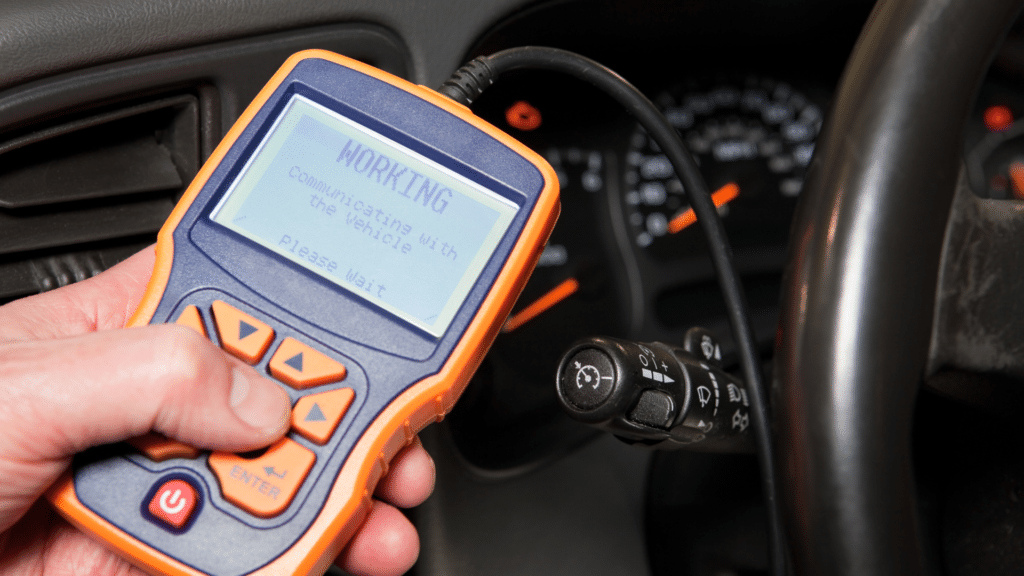
Because P1101 is manufacturer-specific, the very first step is to connect VCDS, ODIS or an equivalent VAG-specific scan tool and read the exact code text as the ECU itself defines it. This avoids the entire generic-OBD-II MAF trap. Most VAG vehicles will return wording in the style of “O2 Sensor B1 S1: voltage too low/leakage”.
Step 2 – Read live fuel trims
Live short-term and long-term fuel trim values are the single most useful piece of diagnostic data. Persistently high positive trims (+10% and above) confirm the engine is genuinely lean and the lambda is correctly reporting it – which points to vacuum/air leaks or low fuel pressure. Negative trims or normal trims paired with a low lambda voltage point instead to a wiring or sensor fault.
Step 3 – Read live lambda signals
A healthy upstream sensor at part throttle should switch repeatedly between roughly 0.1V and 0.9V multiple times per second. A signal stuck flat at low voltage is consistent with either a genuine lean condition or a dead sensor. Comparing it to the rear (post-cat) lambda live data quickly shows which side of the system has the problem.
Step 4 – Smoke test the intake for vacuum leaks
If fuel trims confirm a real lean condition, a professional intake smoke test is the cleanest method of finding the leak. Smoke is pumped into the intake at low pressure with the engine off and any leak shows itself visually. On VAG TSI engines we routinely check the PCV diaphragm, charge pipe, intake manifold gasket and oil filler cap seal. DIY methods like spraying carb cleaner around joints are riskier near hot or electrical components and we don’t recommend them.
Step 5 – Inspect the lambda sensor connector and loom
The upstream lambda connector is unplugged and inspected for oil contamination, corroded pins, pushed-back terminals and heat damage. The wiring back to the ECU is traced for chafed insulation, particularly where it runs near hot exhaust components.
Step 6 – Check for exhaust leaks before the sensor
Visual and audible check of the exhaust between the manifold and the upstream sensor mount. Manifold-to-downpipe gaskets, flexi-pipe failures and corroded sections all let fresh air into the exhaust stream and skew the lambda reading.
Step 7 – Check fuel pressure (if needed)
If everything above checks out and the engine is still genuinely lean, the fuel pressure at the rail needs measuring against VAG service data for the specific engine code. Low pressure points to a tired in-tank pump, blocked filter or faulty regulator.
Repair solutions
Vacuum / air-leak repair
For the most common VAG cause, the repair is whatever the smoke test revealed: replacement of the PCV diaphragm or valve cover on the EA888, replacement of the charge pipe on the 1.4 TSI, new intake manifold gasket, etc. Clearing fuel trim adaptations after the repair is essential so the ECU relearns its baseline correction values.
Lambda sensor replacement
If diagnosis pointed to the sensor itself, replacement is straightforward – unplug the connector, unscrew the sensor with a lambda socket, thread in the new one with a smear of high-temperature anti-seize and reconnect. Always fit OE-spec or recognised aftermarket (Bosch, NTK). Generic universal sensors with crimped wires can work but are less reliable long-term and a common cause of repeat P1101 faults a few thousand miles later.
Wiring or connector repair
If wiring or connector damage was found, the right repair is to splice in a new section of correctly-rated wire, fit a new connector if pins are damaged, and protect the loom with proper sheathing. Tape-and-hope repairs near hot engine bay components don’t last.
Exhaust leak repair
If a leak ahead of the sensor was found, sealing or replacing the affected section will usually clear P1101 once the lambda is reading a true exhaust stream again. Common repair points on VAG cars include the flexi-pipe (often replaced as a full mid-section) and the manifold-to-downpipe gasket.
Clear the code and verify
Once the underlying fault is fixed, the code is cleared and the car is driven through a full drive cycle so the OBD readiness monitors complete – the lambda monitor needs sustained driving to fully reset. The technician then confirms P1101 doesn’t return and the upstream lambda live response looks healthy (rapid switching between rich and lean).
Is it safe to drive with a P1101 code?
Short journeys to a workshop are usually fine, but sustained driving with a faulty upstream lambda is not. The ECU loses accurate fuel trim, which can run the engine genuinely lean – overheating the catalyst, scorching exhaust valves and increasing emissions. If you can smell strong petrol at the exhaust or the car is hesitating badly, get it scanned soon. You can book a proper VAG-level diagnostic at our Worthing diagnostics centre for a same-day visit in most cases.
Will P1101 fail the MOT?
Yes. Under current DVSA MOT rules an engine management light that stays on with the engine running is an automatic fail under the malfunction indicator lamp check. A lean-running petrol engine will often also fail the tailpipe emissions test on lambda value or excess hydrocarbons. Repair the underlying fault, clear the code, complete a short drive so the OBD readiness monitors set, then present the car for MOT.
VAG models most affected by P1101
P1101 turns up across the VAG petrol range and is most common on the 1.4 TSI, 1.8 TSI and 2.0 TFSI EA888 engines – VW Golf, Polo, Audi A3/A4, Skoda Octavia, SEAT Leon – where vacuum leaks from cracked PCV diaphragms, ageing upstream lambda sensors and split charge pipes are well-known issues. Older 1.6 and 2.0 FSI engines see it as the original lambda sensors approach the end of their useful life. Less common on TDI engines, where lambda strategy and code numbering differ. Our Volkswagen specialist team and Audi specialist team diagnose P1101 regularly.
Conclusion
P1101 on a VAG vehicle is the upstream lambda sensor (Bank 1 Sensor 1) reporting voltage too low or detecting what looks like an air leak. It is not a Mass Airflow code – that’s the Ford definition. The dominant real-world cause on VAG petrol engines is a vacuum or intake air leak (PCV diaphragm splits on the EA888 are the headline issue), followed by an ageing lambda sensor, wiring damage, exhaust leaks ahead of the sensor, and low fuel pressure. Proper diagnosis starts with confirming the correct code definition on VAG-specific software and reading live fuel trims to tell whether the sensor itself or the engine running condition is at fault.
If you’re local to West Sussex, you can book a VAG diagnostic check with our Worthing team and we’ll confirm the precise definition for your specific car, read live lambda and fuel trim data, and identify whether the fault is in the sensor, the wiring, an intake leak or an exhaust leak – usually in a single visit. For a wider explanation of how VAG fault codes are structured, see our complete VAG error-code reference.
Frequently Asked Questions about P1101
P1101 is a VAG manufacturer-specific code (VAG number 17509). On Volkswagen, Audi, SEAT and Skoda vehicles it is defined as ‘O2 Sensor (Bank 1 Sensor 1) Voltage Too Low / Leakage’. That refers to the upstream lambda sensor – the one fitted in the exhaust before the catalytic converter – sending a persistently low voltage to the ECU, or the ECU detecting what behaves like a vacuum/air leak via the lambda signal. Note: P1101 means something completely different on Ford (a MAF code), which is why generic OBD-II databases often mis-describe it for VAG.
Related fault codes
Other codes affecting the same system. A stored code often arrives alongside its neighbours.
Seeing P1101 on your VW or Audi?
A stored code tells you where to look, not what has failed. Our technicians read the live data, confirm the real cause and quote before any work begins - so you are not paying for guesswork.
Get the code read properly
Main-dealer-level diagnostics in Worthing, from the longest running garage in town. Call the workshop or book online in under a minute.